


Tag: Maharashtra Rent Control Act

Summary procedure under Maharashtra Rent Control Act (1)
Breaking News Local Laws

Summary procedure under Maharashtra Rent Control Act

Summary Procedure under MRCA Maharashtra Rent Control Act, enacted in the year 1999, is a welfare legislation that protects the interests of tenants and recognizes the rights of the landlord. This act provides a special procedure of eviction for certain categories of landlords. These provisions are included to give protection to certain categories of landlords and ensure the speedy dismissal of eviction disputes. Under chapter VIII, sections 39 to 52 discuss this procedure in detail. Important Provisions : Summary procedure under Maharashtra Rent Control Act CHAPTER VIII SUMMARY DISPOSAL OF CERTAIN APPLICATIONS S.39 Provisions of this Chapter to have over-riding effect.S.40 Appointment of Competent Authority.S.41 Definition of landlord for Chapter VIII.S.42 Special provision for making an application to the Competent Authority by alandlord to evict a tenant or licensee.S.43 Special procedure for disposal of applications.S.44 Order of Competent Authority to be non-appealable and revision by the StateGovernment. What is a Summary Suit? A summary suit is a type of legal proceeding that is designed to ensure the speedy disposal of certain matters, where the defendant has no real defence. Summary suit procedure focuses on the quick resolution of disputes. S.39 Provisions of this Chapter to have over-riding effect S.39 comes with a non-obstante clause, which gives the provisions of this Chapter or any rule made thereunder a notwithstanding effect. Anything inconsistent with the provisions of this chapter, in the Act, or in any other law will be overridden. This section makes the whole chapter important over any other provision or law. S.40 Appointment of Competent Authority S. 40 directs the state government to appoint the competent authority, which is empowered with certain powers and functions. The State Government may, by notification in the Official Gazette, appoint one or more persons to be called the Competent Authority. One or more such Competent Authorities may be appointed for one or more such local areas. A person to be appointed as a Competent Authority shall be: S.41 Definition of landlord for Chapter VIII Chapter VIII states about summary disposal, but it is not available for every dispute governed by this act. The title of this chapter states that only certain matters can be disposed of through this procedure. Only a certain category of landlords can seek summary disposal. S. 41 defines the landlord who can seek summary disposal. The following landlords are included in the definition: Only this category of landlords can seek summary disposal. S.42 Application to the Competent Authority by a landlord to evict a tenant or licensee A landlord defined under section 41 can file an application as if it were a plaint, for eviction of the rented or licensed premises. Subject to the provisions of section 22 or 23 or 24, as the case may be, a landlord may submit an application to the Competent Authority, signed and verified in a manner provided in the Order VI rules 14 and 15 of the Civil Procedure, 1908. Provided, Authority must have jurisdiction over the area in which the premises are situated. S.43 Special procedure for disposal of applications S. 43 lays down the special procedure for the disposal of applications. This procedure ensures that a matter is quickly disposed of through day-to-day hearings without delay. The procedure ordinarily includes the following steps- S.44 Order of Competent Authority to be non-appealable and revision by the StateGovernment Section 44 grants protection to the order of the competent authority passed during the summary procedure by making it non- appealable. While no appeal is allowed, this section provides the alternate remedy of revision. Although these orders are non appealable but state government has the power of revision. Conclusion The Maharashtra Rent Control Act, 1999, is a welfare legislation. Through its provisions of summary procedure, it protects the rights and interests of certain categories of landlords. This ensures speedy disposal of cases and forms a part of effective enforcement mechanism of the act.

Provisions For Recovery Of Possession By Members Of Armed Forces (1)
Civil Law

Provisions For Recovery Of Possession By Members Of Armed Forces 2026

Members of the armed forces and some other categories of landlords follow special provisions for the recovery of possession. This procedure is often known as a summary procedure. The procedure for the recovery of possession by members of the armed forces is different from the procedure for the recovery of possession from other landlords. Chapter V deals with the special provisions regarding the recovery of possession in certain cases. Important Provisions S.23. Members of armed forces of the Union, scientists, or their successors-in-interest are entitled to recover possession of premises required for their occupation.S.40. Appointment of Competent Authority.S.41. Definition of landlord for Chapter VIII.S.42. Special provision for making an application to the Competent Authority by a landlord to evict a tenant or licensee.S.43. Special procedure for disposal of applications.S.44. Order of Competent Authority to be non-appealable and revision by the State Government. Summary Procedure Members of the armed forces can recover possession by summary procedure. A summary suit is a type of legal proceeding that is designed to ensure the speedy disposal of certain matters, where the defendant has no real defence. Summary suit procedure focuses on the quick resolution of disputes. Categories Of Landlord Only a certain category of landlords can seek summary disposal. It is not available for every landlord. Only certain categories of landlords can recover possession of premises required for their occupation.The following landlords can come under S.23 for recovery of possession: Only this category of landlords can seek summary disposal. Grounds For Recovery Of Possession Under S.23 Authorised officer for granting certificate Successor-in-interest under S.23 Successors in interest of the landlord mentioned under S. 23 are also eligible to recover possession. This successor in interest may be: S.40 Appointment of Competent Authority S.40 directs the state government to appoint the competent authority, which is empoweredwith certain powers and functions. The State Government may, by notification in the OfficialGazette, appoint one or more persons to be called the Competent Authority. One or moresuch Competent Authorities may be appointed for one or more such local areas. A person to be appointed as a Competent Authority shall be: S.42 Application to the Competent Authority by a landlord to evict a tenant or licensee. A landlord defined under section 41 can file an application as if it were a plaint, for eviction of the rented or licensed premises. Subject to the provisions of section 22 or 23 or 24, as the case may be, a landlord may submit an application to the Competent Authority, signed and verified in a manner provided in the Order VI rules 14 and 15 of the Civil Procedure, 1908. Provided, Authority must have jurisdiction over the area in which the premises are situated. S.43 Special procedure for disposal of applications S. 43 lays down the special procedure for the disposal of applications. This procedure ensures that a matter is quickly disposed of through day-to-day hearings without delay. The procedure ordinarily includes the following steps- If the tenant fails to file an application seeking leave, the landlord’s version of the case willbe considered right, and the court can pass an eviction order. Conclusion The Maharashtra Rent Control Act, 1999, is a welfare legislation. Through S. 23, it protects the rights and interests of certain categories of landlords, including members of the armed forces. This ensures speedy disposal of cases and forms a part of an effective enforcement mechanism of the act. Whereas, limited grounds for eviction and the requirement of a certificate from the authorizing officer also protect the tenant from arbitrary eviction.

Defination of standard rent
Local Laws Uncategorized

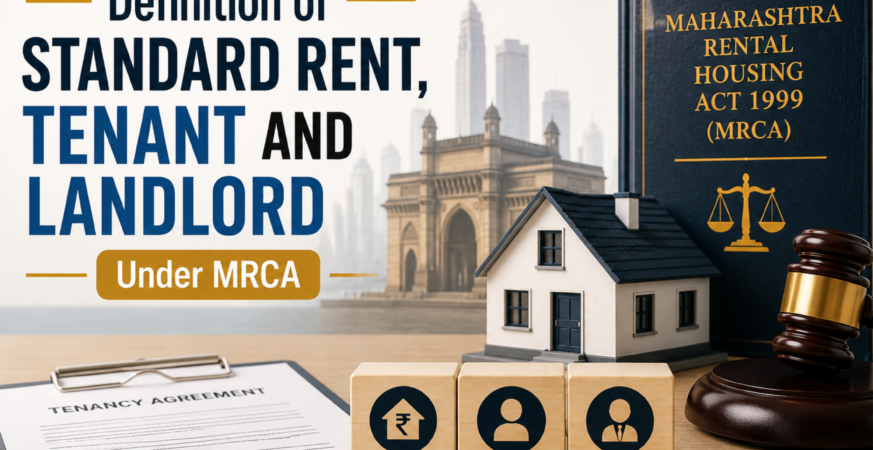
Definition of Standard rent, Tenant And Landlord Under MRCA 1999

Due to industrialization, a huge number of people migrated from rural areas to urban areas, thereby raising the demand for tenanted premises. This sudden shift in demand for tenanted premises gave rise to unfair practices like excess rent, unlawful eviction, etc. In order to address all these problems and ensure uniform application of law throughout the state, the Maharashtra Rent Control Act was introduced as a welfare legislation. To ensure consistency in legislation and correct interpretation, the act provides some important definitions, such as standard rent, tenant, and landlord. Important Provisions Definitions Under MRCA Being enacted as a welfare legislation, MRCA ensures consistent and uniform application of the law through its definitions. Various Definitions under the MRCA form a foundation of the act. They are one of the most important parts of the act. The definitions under MRCA are of wider scope. These definitions are inclusive and avoid escaping due to mechanical interpretation. The scope of the definitions has been kept wider purposefully to provide greater coverage. Section 7 of the act defines all the necessary terms important for the uniform application with their wide scope. S.7(3) Landlord “Landlord” means any person who is, for the time being, receiving, or entitled to receive rent in respect of any premises, whether on his own account or on account of or on behalf of any other person. This definition is of wide scope and inclusive. To be a landlord, receiving rent is more important than having the ownership title. It is not necessary to have legal title over the premises or ownership rights to be a landlord under this act. In simple language, the person who receives the rent or who is entitled to receive the rent is the landlord. A landlord can be the owner of premises or anyone legally entitled to receive the rent on behalf of the owner. The landlord can be: S.7(14) Standard Rent In simple language, legally recoverable rent from the tenant is standard rent. Standard rent is a standardized amount set as rent. This concept was introduced to protect tenants from excess rent. A landlord cannot charge rent that is higher than the standard rent.This amount may be fixed by: Standard rent consists of basic rent payable by the tenant. However, in certain situations, the landlord can also ask for a permitted increase, which is 5% of the standard rent. Permitted increases could be charged due to a hike in municipal taxes, increased facilitiesHence,Total Rent Payable = Standard Rent + Permitted Increase S.7(15) Tenant Tenant is the person liable to pay standard rent to the landlord. Tenant is also defined as a person on whose account rent is payable. “tenant” means any person by whom or on whose account rent is payable for any premises, and includes any person who is Conclusion These definitions are of core importance in connection with the interpretation of the act. A wider scope of these definitions ensures greater coverage and prevents individuals from letting off their liability due to a mechanical interpretation of the definition.

About Us

Lorem ipsum dol consectetur adipiscing neque any adipiscing the ni consectetur the a any adipiscing.

Email Us: answeringlaw1@gmail.com

Answeringlaw  @2024. All Rights Reserved.