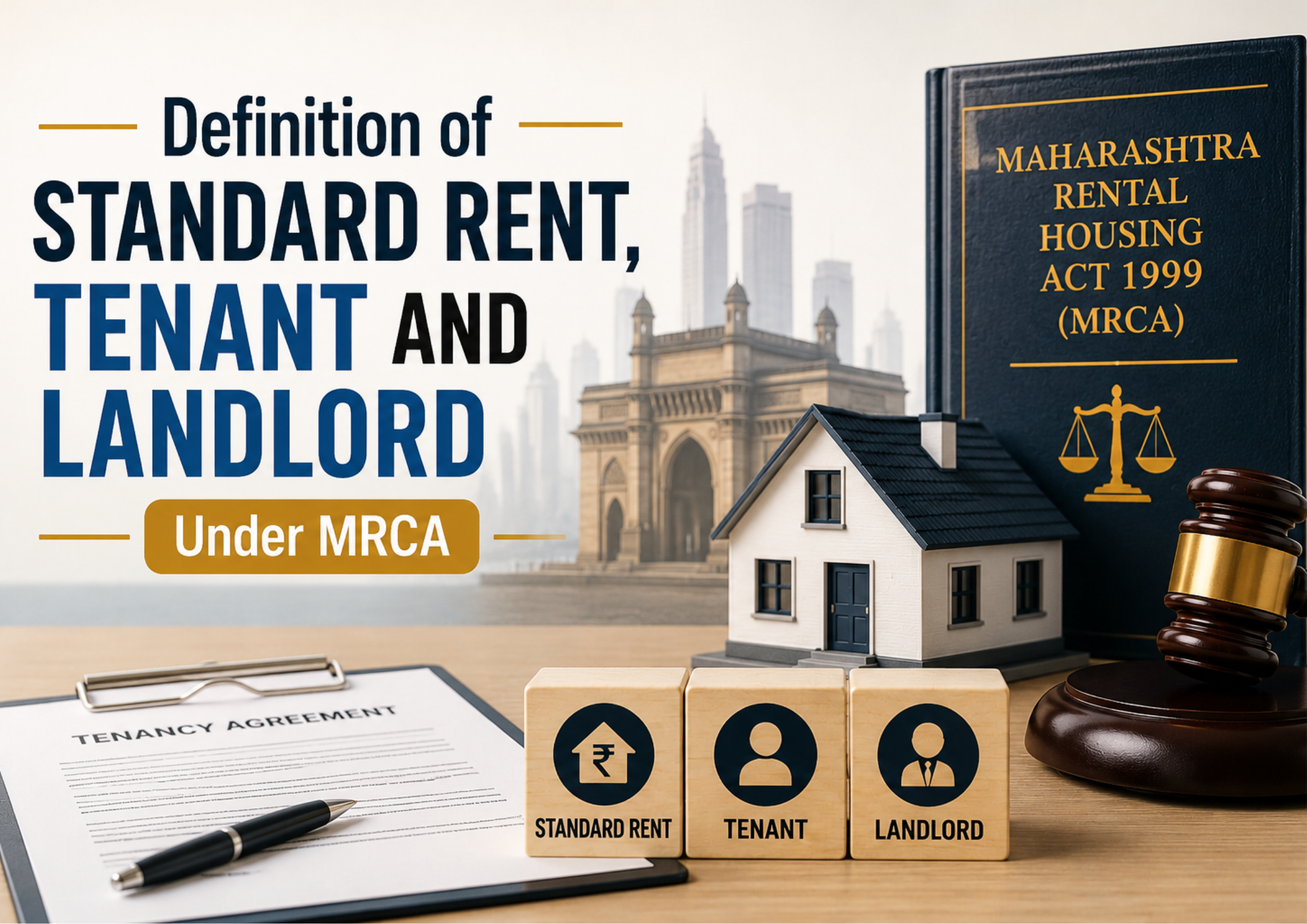


Due to industrialization, a huge number of people migrated from rural areas to urban areas, thereby raising the demand for tenanted premises. This sudden shift in demand for tenanted premises gave rise to unfair practices like excess rent, unlawful eviction, etc. In order to address all these problems and ensure uniform application of law throughout the state, the Maharashtra Rent Control Act was introduced as a welfare legislation. To ensure consistency in legislation and correct interpretation, the act provides some important definitions, such as standard rent, tenant, and landlord.
Important Provisions
- S.1. Short title, extent and commencement.
- S.2. Application.
- S.7. Definitions.
- S.7(3) Landlord
- S.7(14) Standard Rent
- S.7(15) Tenant
Definitions Under MRCA

Being enacted as a welfare legislation, MRCA ensures consistent and uniform application of the law through its definitions. Various Definitions under the MRCA form a foundation of the act. They are one of the most important parts of the act. The definitions under MRCA are of wider scope. These definitions are inclusive and avoid escaping due to mechanical interpretation. The scope of the definitions has been kept wider purposefully to provide greater coverage.
Section 7 of the act defines all the necessary terms important for the uniform application with their wide scope.
S.7(3) Landlord
“Landlord” means any person who is, for the time being, receiving, or entitled to receive rent in respect of any premises, whether on his own account or on account of or on behalf of any other person.
This definition is of wide scope and inclusive. To be a landlord, receiving rent is more important than having the ownership title. It is not necessary to have legal title over the premises or ownership rights to be a landlord under this act. In simple language, the person who receives the rent or who is entitled to receive the rent is the landlord. A landlord can be the owner of premises or anyone legally entitled to receive the rent on behalf of the owner.
The landlord can be:
- A person actually receiving rent
- A person entitled to receive rent
- A person (not being a tenant) deriving title under the landlord
- A person who would be entitled to receive rent if the premises were let
- A person receiving rent on behalf of another, such as:
- Agent
- Manager
- Trustee
- Guardian
- Representative
S.7(14) Standard Rent
In simple language, legally recoverable rent from the tenant is standard rent. Standard rent is a standardized amount set as rent. This concept was introduced to protect tenants from excess rent. A landlord cannot charge rent that is higher than the standard rent.
This amount may be fixed by:
- Previous rent legislations
- Rent, decided by the court
- Amount agreed mutually between landlord and tenant
Standard rent consists of basic rent payable by the tenant. However, in certain situations, the landlord can also ask for a permitted increase, which is 5% of the standard rent. Permitted increases could be charged due to a hike in municipal taxes, increased facilities
Hence,
Total Rent Payable = Standard Rent + Permitted Increase
S.7(15) Tenant
Tenant is the person liable to pay standard rent to the landlord. Tenant is also defined as a person on whose account rent is payable. “tenant” means any person by whom or on whose account rent is payable for any premises, and includes any person who is
- Tenant
- Deemed tenant
- Sub-tenant, permitted under the act
- Who has derived title under a tenant
- To whom interest in premises has been assigned or transferred
- Family member of the tenant, paying rent
Conclusion
These definitions are of core importance in connection with the interpretation of the act. A wider scope of these definitions ensures greater coverage and prevents individuals from letting off their liability due to a mechanical interpretation of the definition.